
"A 280% surge—we were forced to revise our schematics overnight."
—— This is a quote from a security hardware director in Shenzhen in April 2025.
The SLC NAND market experienced a rare price explosion. According to TrendForce data, prices nearly tripled within a year, forcing two medium-sized Chinese manufacturers to redesign their products. This article focuses on the practices of these two companies, deconstructing the response strategies of Chinese manufacturers under the impact of "SLC NAND price hikes" and providing a practical action checklist.
Context: Why SLC NAND Suddenly Skyrocketed
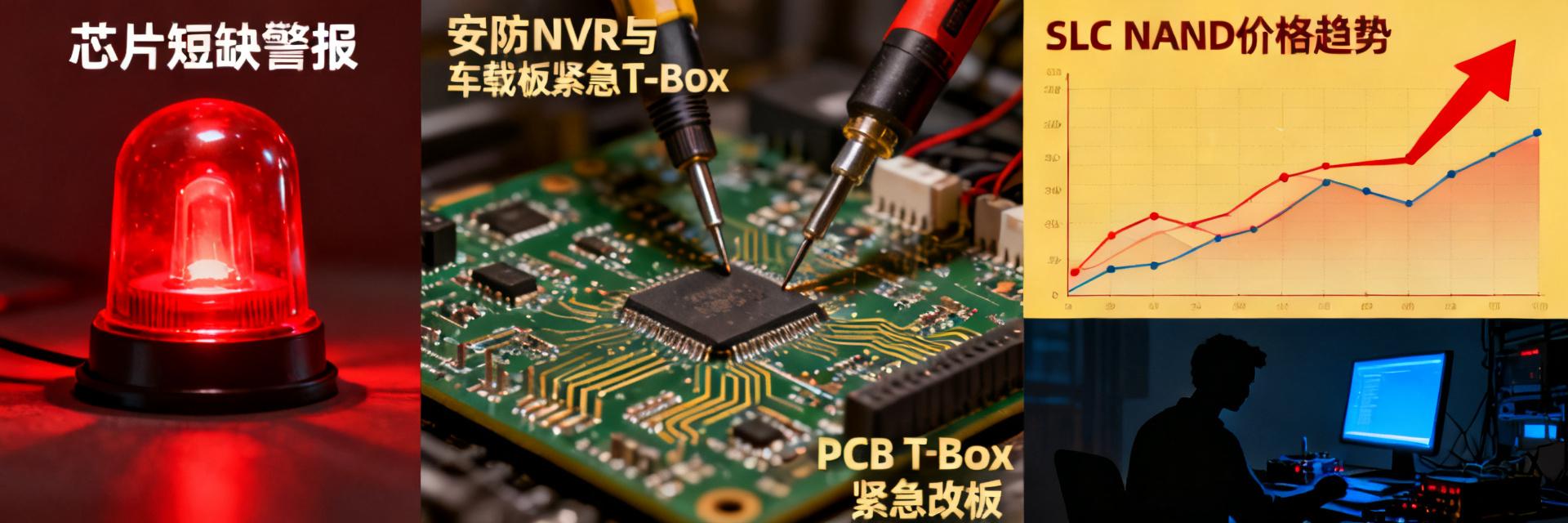
Fig: Schematic of SLC NAND Supply-Demand Structure Fluctuations
Demand Side: Simultaneous Growth in Security, Automotive, and Industrial Control
The simultaneous expansion of three major scenarios—security edge AI boxes, automotive T-Boxes, and industrial PLCs—led to an annual SLC NAND demand growth exceeding 55%. Among them, HD NVRs require continuous 7×24 writing, and automotive-grade T-Boxes must operate between -40°C and 105°C. Both have rigid requirements for SLC lifespan and reliability, making it difficult to replace with MLC or QLC in the short term.
Supply Side Collapse: Chain Reaction of EOL and MLC Production Line Conversion
Samsung and Kioxia successively converted 8Gb SLC production lines to high-margin automotive MLC, causing the SLC supply gap to widen instantly. Although some second-tier wafer fabs plan to expand capacity, the lead times for photoresist and CMP consumables have lengthened, with actual mass production not expected until 2026. The supply-demand gap continues to grow, with prices soaring from $0.18 per Gb to $0.52 per Gb, hitting a ten-year high.
A Case Analysis: Factory A's Security NVR Forced to Reduce Capacity
Timeline: Only 14 Days from Price Hike Notice to Board Revision
On April 2, Factory A received a shortage warning for the main control BGA; on April 5, SLC quotes hit an all-time high; on April 9, the hardware team urgently evaluated alternative materials; on April 16, the new PCB prototyping was completed, compressing the original 8Gb SLC solution to 4Gb with algorithm slimming. The total BOM increased by only $0.7 to restore availability.
Technical Trade-offs: Pros and Cons of the SLC → pSLC + eMMC Hybrid Solution
The team ultimately kept the 64KB log area on the original SLC to ensure power-off safety; the large-capacity video cache was migrated to eMMC in pSLC mode, and LDPC soft decoding was enabled to reduce error rates. Field tests showed continuous write lifespan decreased from 15 to 12 years, still exceeding the customer's 10-year warranty requirement, successfully avoiding production shutdown risks.
B Case Analysis: Factory B's Automotive T-Box Urgent Material Change
Supply Chain Maneuvers: Spot Buying, Quota Negotiation, and Secondary Surcharges
Factory B visited five distributors within two weeks to secure the last batch of spot stock for TC58BVG1S3HBAI6. Although the unit price was 36% higher than the contract price, it guaranteed no shortages in Q2. They then negotiated with the SoC vendor, exchanging a 12-month volume commitment for the next batch of quotas, successfully keeping the secondary price hike under 10%.
Cost Pass-through: Software Algorithms Compress NAND Usage by 25%
The software team used differential logs + LZ4 stream compression to reduce CAN message storage from 1.6MB/h to 1.2MB/h; simultaneously, FAT32 was changed to an append-only ring log format, extending the erase cycle by 30%. Ultimately, without cutting features, NAND capacity was reduced from 4Gb to 3Gb, offsetting most of the price pressure.
Methodology: Three-Level Response Framework for Chinese Manufacturers
Short-term: Stop the Bleeding
- Purchase critical part numbers from spot market
- Deep firmware slimming
- Launch low-spec version stratification
Medium-term: Risk Mitigation
- Second source backup
- Compatible design for SLC and pSLC
- Quarterly price-lock contracts
Long-term: Restructuring
- Shift to QLC + LDPC architecture
- Optimize in-house FTL controller
- Localization of alternative verification
2025 Action Checklist: 7-Day, 30-Day, 90-Day Implementation Guide
Future Outlook: New Storage Landscape and Opportunities for Chinese Vendors
Technical Tiering: Over the next five years, SLC will focus on ultra-high reliability scenarios, pSLC will cover the industrial mainstream, and QLC will enter high-capacity automotive markets with its cost advantage. Tiered storage will force small and medium-sized manufacturers to perform more meticulous selection.
Market Stratification: High-end security can accept pSLC + algorithm premiums, while automotive pre-installation favors QLC + redundant design. Chinese manufacturers who layout QLC automotive-grade verification early will gain the upper hand in the next round of order competition.
Key Takeaways
- SLC NAND annual price increase reached 280%, with security and automotive as the most affected areas.
- A three-level response framework: 7-day spot buying, 30-day firmware slimming, and 90-day QLC research.
- Success cases prove: the earlier an alternative solution is initiated, the better passive situations can be turned into active ones.
FAQ
Q: How long will the SLC NAND price hike last?
A: The supply gap will persist at least until 2026, and high-level price fluctuations will become the new normal.
Q: Is spot stock for TC58BVG1S3HBAI6 still available?
A: Three major spot distributors in South China currently have scattered stock. The unit price has risen by 30%, so immediate locking is recommended.
Q: How long does QLC automotive-grade verification take?
A: From samples to AEC-Q100 certification typically takes 12 months. Starting now allows for mass production by Q2 2026.
